
New Apple Ads Search Placements in 2026
What changes has Apple announced for Apple Ads in 2026? How will these changes affect the daily number of organic downloads from search? What factors will influence the chances of an ad being displayed in Apple Ads search results? You’ll find answers to all of this in the article below.
For mobile app and game developers and marketers, App Store search results are one of the most important battlegrounds for user acquisition. The effectiveness of this channel is undeniable — Apple’s data shows that nearly 65% of downloads occur directly after a search.
In 2026, Apple is fundamentally changing the rules of this competition by introducing major updates that will redefine user acquisition strategies within paid App Store search results.
More Ads in Search Results starting in 2026
Beginning in 2026, Apple Ads will introduce additional ad placements within search results. This means that, in addition to the current single ad position at the very top of the results page, ads will also be eligible to appear further down in the search results.
From a strategic perspective, this change has two key implications. On one hand, the increased supply of ad placements may initially lead to a lower average cost per tap (CPT). On the other hand, it introduces greater visual competition and the potential devaluation of the prestigious top position. As a result, advertisers will need to develop creatives capable of capturing user attention even when displayed in lower positions on the search results page.
Relevance matters more than budget
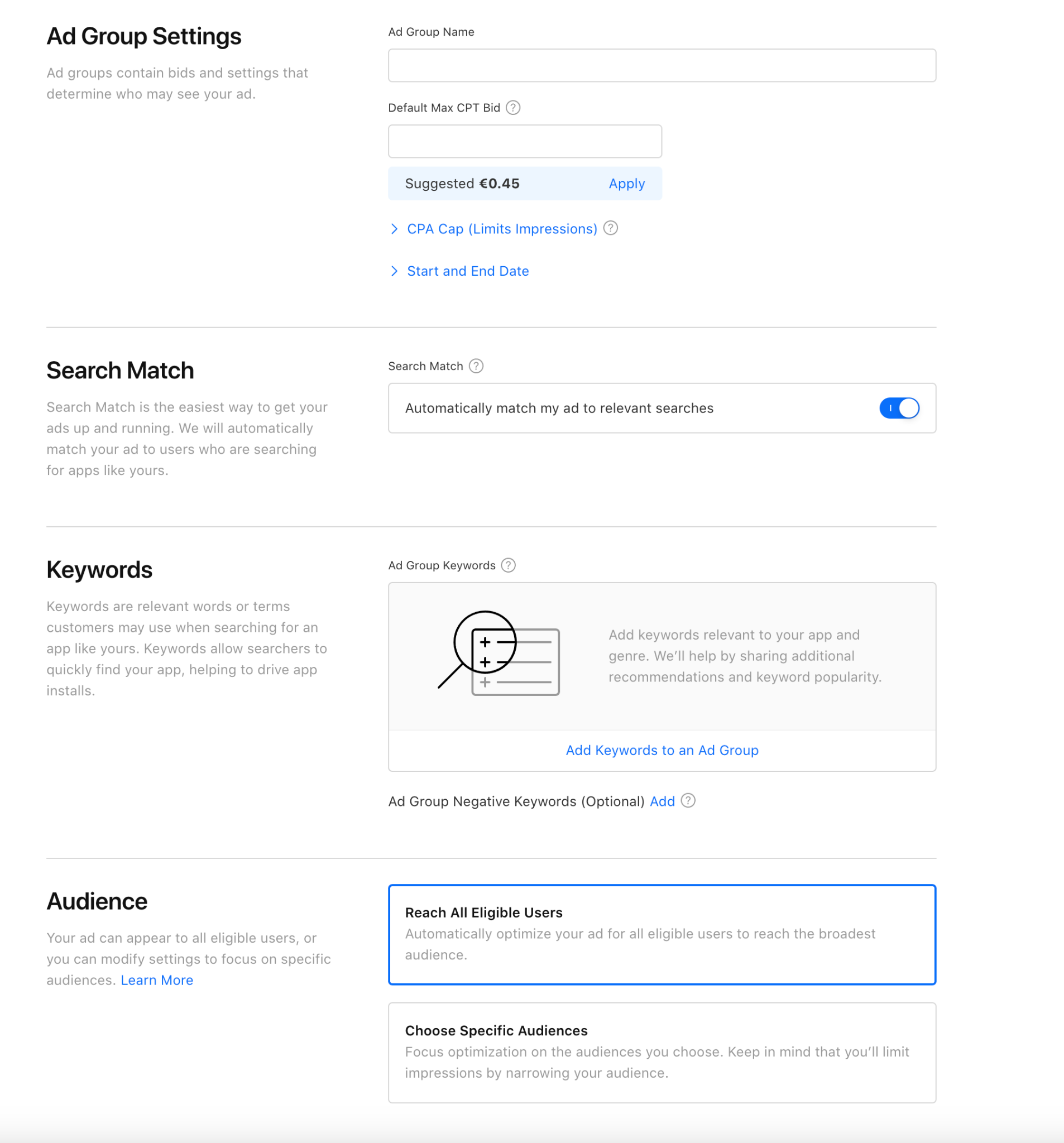
Apple decides which ad is shown based on a combination of “the app’s relevance to the search query and the keyword bid amount.” This is likely the most important takeaway from the announced changes. Unlike many other advertising systems, a high bid alone does not guarantee an impression. This directly ties the success of paid campaigns to App Store Optimization (ASO). Apple’s algorithm will evaluate “relevance” based on the app’s metadata. In other words, a strong ASO strategy becomes an absolute prerequisite for spending advertising budgets effectively.
Apple clearly emphasizes that relevance is a mandatory requirement. An app that is not relevant to a given query will not even be allowed to enter the auction — regardless of how high the bid is. If your app does not match what the user is searching for, it will not be shown — no matter how much you are willing to pay. How this will work in practice remains to be seen 🙂
One campaign, all positions — no ability to choose
Existing search result campaigns will “automatically qualify for all available placements,” and advertisers will not be able to “select or bid on a specific position.” This is a classic trade-off between simplicity and control. On one hand, automation simplifies campaign management. On the other, it removes a key control lever for advanced marketers — the ability to bid separately for premium top-of-page placements versus lower positions. Full trust in Apple’s algorithm will be required.
Unchanged mechanics and pricing for operational cimplicity
Despite the introduction of new placements, Apple is prioritizing ease of adoption. The ad format will remain the same, using either the default App Store product page or a custom product page. Moreover, the pricing model will remain unchanged. Advertisers will continue to be charged on a cost-per-tap (CPT) basis. This simplifies the transition and avoids the need for a fundamental overhaul of existing pricing strategies.
How will Apple Ads Search changes impact App Store Optimization?
Within the industry, there are voices suggesting that the new ad placements could reduce the importance of App Store Optimization. I don’t believe that will be the case. By the end of 2025, relying solely on keyword and metadata optimization in the App Store has, in my opinion, very limited potential. Reaching top positions without paid user acquisition campaigns is extremely — extremely — difficult.
Most developers who rely only on organic traffic and do not have a strong brand will never be able to scale downloads in the App Store without paid campaigns. They will remain at daily download volumes in the tens. This is no longer 2012. Those currently getting a few dozen organic downloads per day will likely stay at similar levels.
What’s next for Apple Ads in the App Store?
In summary, the upcoming changes introduce more ad placements while simultaneously placing unprecedented emphasis on relevance and automating ad placement decisions. This is a strategic move that could fundamentally reshape competitive dynamics and raises a critical question for the entire industry:
Do you think Apple’s focus on relevance over budget will create a fairer advertising ecosystem for developers — or will it simply reinforce the dominance of apps that already lead organic search results?

What is Google ICM (Integrated Conversion Measurement)?
What changes has Apple announced for Apple Ads in 2026? How will these changes affect...