

A game economy isn’t a spreadsheet of prices. It’s the system that decides how fast players progress, when they feel satisfied, and when they’re willing to watch an ad or buy something. A well-designed economy is invisible: the player simply wants “just one more level.” A badly designed one shows itself quickly, because players either get bored within an hour or hit a wall and uninstall.
Below are principles that hold regardless of genre: puzzle, idle, simulation, RPG or hybrid-casual. The examples deliberately come from different kinds of games, because the mechanics underneath are the same.
1. Start with the loop, not the prices
Before you type a single number, describe in one sentence what the player does over and over. That’s the core loop, and the entire economy exists to keep that wheel turning at the right speed. A few examples:
- puzzle / match-3: beat a level → earn coins and stars → buy boosters or decorations → beat harder levels,
- idle / tycoon: produce → earn → upgrade production → produce faster,
- RPG: fight → collect loot → upgrade gear → beat stronger enemies.
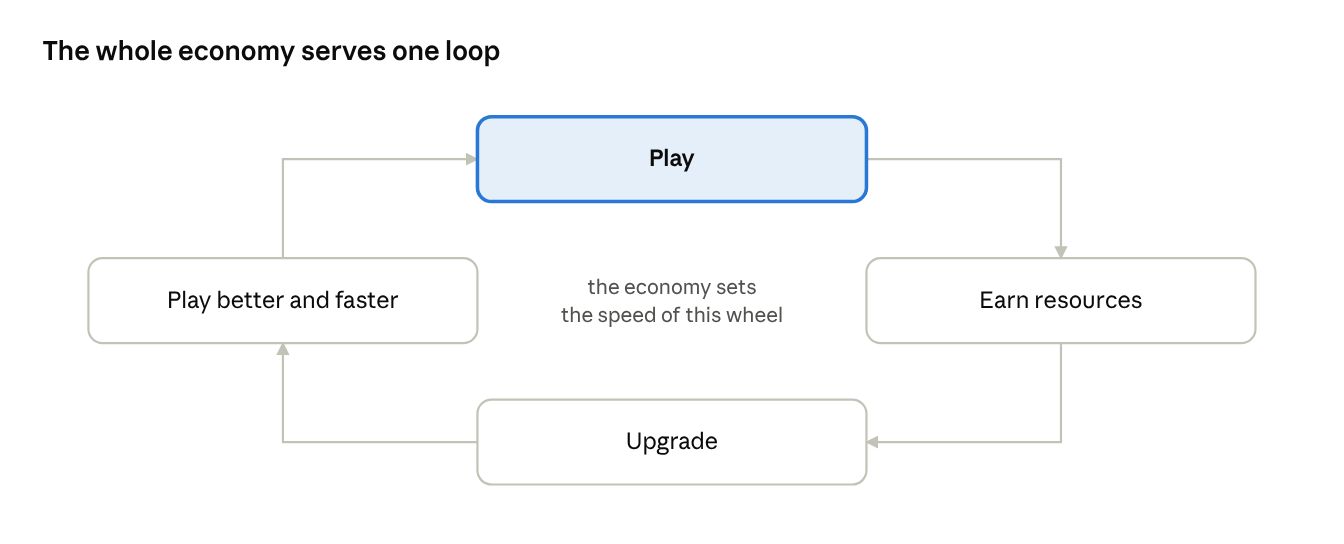
core loop · 4 steps
Too slow, and players get bored and leave. Too fast, and they finish the game in an hour with no reason to come back, watch ads or pay. Every decision below is, at heart, a way of tuning the speed of that wheel.
2. Two currencies and one exchange rate
Most free-to-play games have two currencies, and each has a different job:
- Soft currency (coins, gold, in-game cash) drives progress: upgrades, new buildings, gear. Players earn it by playing.
- Hard currency (gems, diamonds, energy) buys time and convenience: skipping a timer, extra moves in a puzzle, finishing construction instantly. Players get very little of it for free, which is what gives it value.
This split makes the player an honest promise: you can reach every goal for free, just more slowly. Paying or watching ads buys time, not the right to play.
The second pillar is one fixed exchange rate between real money, soft and hard currency, e.g. “$1 = X coins = Y gems.” You derive everything from it: store bundles, ad rewards, costs. That way every offer can be compared with every other one, and players intuitively feel the prices make sense.
3. Taps and sinks: where currency comes from and where it goes
In game economy design we talk about taps and sinks, often also called faucets and drains. Picture a bathtub: taps are everything that adds currency to the game, sinks are everything that removes it. If more flows in than out, players quickly have too much, prices lose meaning and nothing motivates them (that’s inflation). The other way round, they get frustrated.
Typical taps:
- the reward for the core action: a finished level, a defeated enemy, a produced item,
- small, frequent bonuses: chests, tips, combos, “found” coins — small rewards that also give players a reason to do the less exciting chores,
- rewards for returning and engaging: daily login, daily quests, rewarded ads, offline earnings in idle games.
Typical sinks:
- running costs: materials, fuel, repairs — a reminder that nothing is free,
- unlocks and upgrades: the main, big expense that drives progression,
- things rented for a time instead of bought forever (helpers, boosters, timed bonuses): the cost keeps coming back throughout the game,
- late-game sinks: cosmetics, prestige/rebirth, collections — for when everything else has been bought.
Good practice: whenever you add a new tap, ask right away which sink that currency will drain through. Also give players decisions, such as setting prices in a tycoon game, choosing an upgrade path in an RPG, or picking which booster to bring into a level. Players then feel they authored their own success, and the currency gets a concrete, worthwhile use.
4. Progression pacing: often, a little at a time, and without end
Early in the game, levels and rewards should come often — every few minutes, and in puzzle games even every level. Each reward is a small dose of satisfaction, and the first minutes decide whether the player stays at all.
Three rules worth copying:
- Every level gives something. Even if there’s no new character or building, the player gets a small bonus: a few percent more production, a bit of currency, a new cosmetic. An empty level-up teaches players that levels mean nothing.
- An unlock has two steps. The level grants the right to buy; currency makes the purchase. Players always have two goals at once — “reach the next level” and “save up for the upgrade” — and rewards are spaced every 1–3 levels.
- Upgrades that grow forever need a ceiling. If each level cuts, say, production time by a fixed amount, you’ll eventually hit zero and break the game. It’s safer when each level takes a fixed percentage of what remains to the limit:
bonus(L) = limit × (1 − qL−1), where 0 < q < 1
The curve rises quickly at first, then more and more slowly, and never exceeds the limit. You can keep adding levels forever and the player always gets something — just less each time. On the other side, upgrade costs usually grow exponentially (e.g. each one 10–15% more expensive), so they keep pace with rising earnings.
Here’s what that looks like with data from a real project: the first 50 levels deliver more than half of the total bonus, and the next 150 add only small increments.
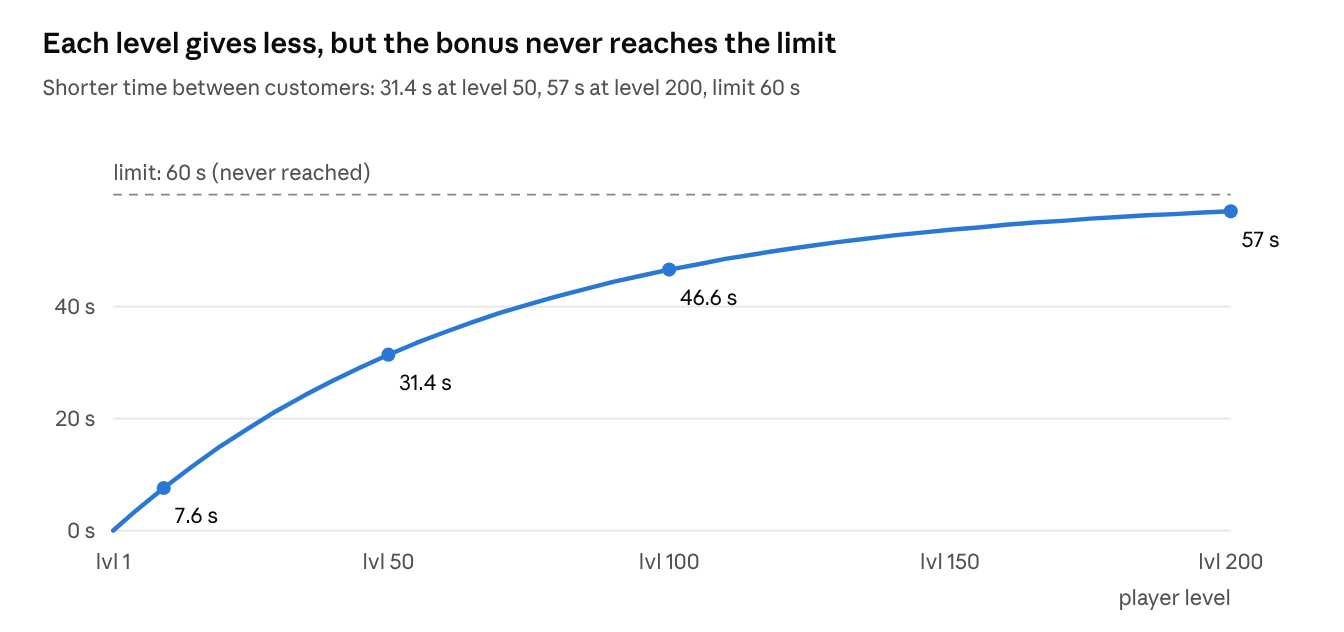
economy model of a real project · customer arrival bonus, levels 1–200
5. Don’t design from scratch
The most common beginner mistake is inventing the whole economy out of thin air. A better route is deconstruction: take a few successful games in your genre, play them with a spreadsheet open, and write down how many minutes pass between rewards, how much each upgrade costs and how fast costs grow, and when the first wall and the first store offer appear.
From those notes you extract proportions and rhythm, not content: how long the early game lasts, how much more each upgrade costs than the last, how many rewards land per hour. On top of that you build your own items, your own numbers and your own unlock order, tailored to your loop and your store.
That way you’re not guessing whether a first upgrade after three minutes is a good idea — you know how games that already reached millions of players do it. Your job is to understand why it works, and to change it deliberately.
6. Test the economy in a spreadsheet before players test it for you
The simplest test is a flow model: step by step (session, in-game day or level) you calculate how much currency the player earns, how much they spend, and what their balance is. Three assumptions are enough: play pace (e.g. reward per minute), session length, and when the player buys each upgrade. Run a few scenarios, such as a player who plays optimally, an average one, and one who watches ads.
The model will often show a point where upgrades get more expensive than earnings, and the balance dips or progress clearly slows. That doesn’t have to be a bug. A well-placed dip is a “soft wall”: it doesn’t block the game, but it makes help from an ad or the store genuinely valuable. Non-paying players learn that an ad shortens the road to their goal, and you know where to place your offers. What matters is that it’s your decision, not an accident.
An example from a real project’s model: the same player, three pricing strategies. At default prices, upgrades outpace earnings and the balance dips below zero several times. Raise prices using hard currency and you skip the dip — which is exactly the incentive the designer intended.
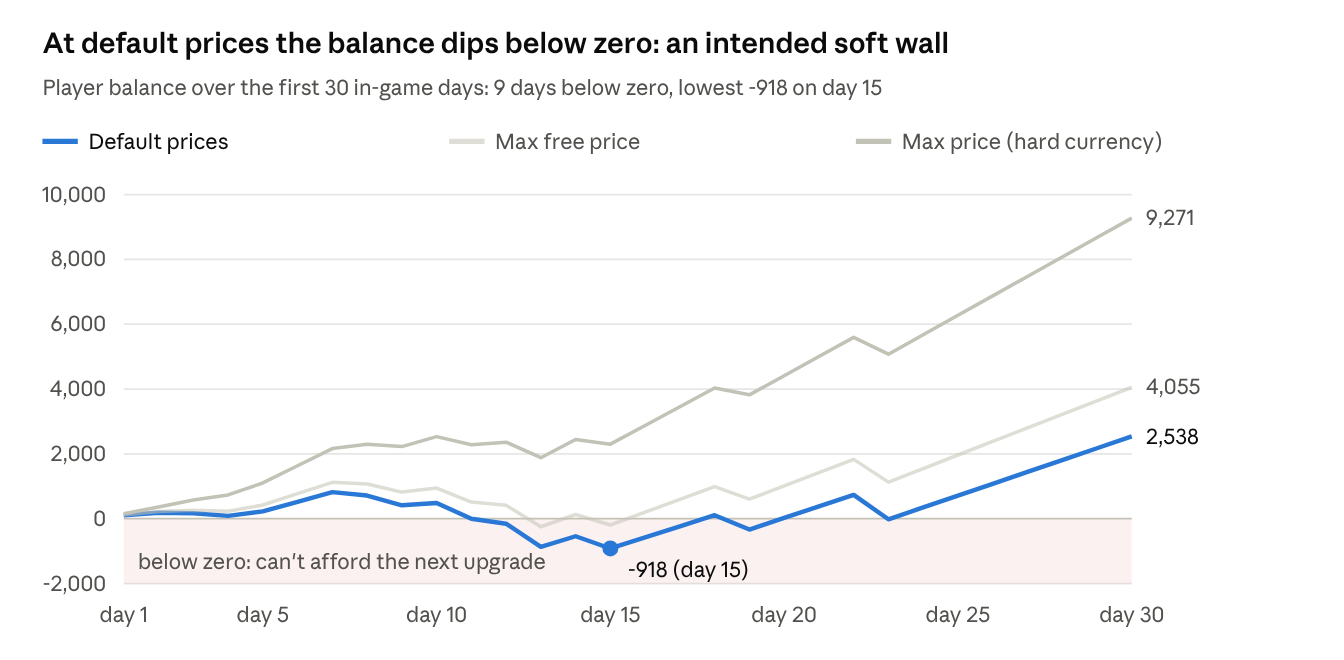
cash-flow model of a real project · three pricing scenarios, 30 in-game days
Two things that are easy to forget:
- Write your assumptions down and check that they’re realistic. If the model assumes uncapped rewards but the game has a cap, your results will be too optimistic.
- Recalculate the model after every change. Change one cost or recipe and leave the sheet as it was, and small differences add up.
7. Ads: two formats, two roles
Interstitials (forced ads) earn from every player, including those who will never buy anything. Three rules:
- show them at natural breaks (after a finished level, on return to the menu, between rounds), never mid-action,
- don’t show them at the very start of the first session, because that’s exactly when the player decides whether to stay,
- give them a cooldown and a daily cap, and lengthen the cooldown after a store purchase — people who paid shouldn’t feel punished.
Rewarded ads (opt-in ads for a reward) belong exactly at points of frustration: out of moves in a puzzle, a build with an hour left, coming back to offline earnings in an idle game (“double with an ad”), losing a runner just short of a record (“continue”). The rule: the ad should solve a problem the player is feeling right now. Then they watch willingly and don’t feel cheated. And don’t clutter the screen — show one, most relevant offer at a time.
Watch the reward value. If 30 seconds of ad gives as much as several minutes of play, players quickly decide playing isn’t worth it, and progression falls apart. It’s safer to set the reward as a percentage of current earnings rather than a fixed amount — that way it grows with the game and stays meaningful early and late.
8. The store: a price ladder and offers at the right moment
Price ladder. Three tiers are enough to start, e.g. $0.99 / $2.99 / $5.99. The pricier the bundle, the bigger the bonus over the base rate (e.g. 0% / +20% / +50%). Players instantly see that “the bigger one is the better deal.”
Starter pack. A cheap offer with very high value (often +100% or more), time-limited, shown once the player is hooked but before the first wall. Its goal isn’t revenue, it’s breaking the first-purchase barrier: people who paid once pay more often.
A store that grows with the player. A new player shouldn’t see twelve offers at once. Products can appear at milestones and stay for good, for example:
- remove ads — after the first interstitial,
- lifting a limit (energy, slots, storage) — the first time the player hits it,
- small currency packs — after the first time that currency is spent,
- larger packs — after the first purchase or midway through the early game.
Every offer answers a problem the player just felt. For players who have already paid, you can show limited offers at the moment of need, e.g. when they’re short of currency right before an important upgrade.
And an iron rule: a premium product sells best next to the free version. A helper or booster that works for a few minutes for free and permanently in the premium version. A VIP pass that gives what ads give, without the watching. Players feel the difference before they see the price.
9. Mistakes that are easy to miss
These slip-ups happen even to experienced teams, because each one looks harmless on its own.
- Confusing in-game time with real time. If an in-game day lasts a few minutes, “an offer from day 3” means a dozen or so minutes into the first session, not the third day after install. Likewise, a cooldown in real hours combined with a level-based trigger means an offer “every 5 levels” will show up far less often. Put a unit next to every number.
- Too many ad opportunities at once. Each ad placement looks reasonable on its own, but together they can add up to an ad every minute of play. Count the total ads per session, not just individual placements.
- Content that runs out too early. If the last unlock lands after two hours of play, players can keep grinding levels, but there are no new goals. That hurts retention and long-term player value. Plan the late game: prestige, new locations, events.
- Conflicting numbers in the documentation. The same value written differently in two places — the programmer will pick one at random. Keep every number in one place (the spreadsheet) and only reference it in the text.
- Items with no data. A new item with no price, or a store offer with no contents. Before handing off the documentation, go through it asking “does everything have a number?”
Starter checklist
- ☐ Core loop described in one sentence.
- ☐ Two currencies with clear roles: soft for progress, hard for time and convenience.
- ☐ One exchange rate: real money ↔ soft ↔ hard currency.
- ☐ Every tap has its sink.
- ☐ Every level gives a reward; infinite upgrades have a ceiling.
- ☐ Rhythm and proportions studied in a few successful games in your genre; your own numbers and content.
- ☐ Step-by-step flow model with written assumptions, in several scenarios.
- ☐ Rewarded ads at points of frustration, reward proportional to earnings, total ads per session counted.
- ☐ IAP price ladder, starter pack, store unlocked at milestones.
- ☐ Every number has a unit (level, in-game day, real time) and lives in one place.
Finally: an economy is never finished on paper. The spreadsheet gives you a good starting point, but the real answers come from soft launch — retention, ads per player and first purchases. Design so that every number is easy to change later.

Peter Plachta
Founder, ARPU Brothers, (Experienced Mobile User Acquisition & ASO Expert since 2012) - Achieved over 240 million app and game installs